Sunday, November 16, 2014

Santa Cecilia en Trastevere

On Tuesday, we visited the church of St. Cecilia in Trastevere.

Cecilia was a devout Christian girl, born to all the luxury of nobility. Despite this, she devoted her life to caring for the sick and poor in the neighborhood across the river from the main part of the city of Rome. This explains the use of "Trastevere" in the name of the church. Trastevere comes from the Latin trans Tiberim, meaning literally "beyond the Tiber." Therefore, the neighborhood across the river where Cecilia ministered to the sick and poor was "across or beyond the Tiber River."

Here's a photo of the church:


The 16-year-old Cecilia had vowed to remain forever a virgin as a sign of total dedication. However, her father arranged for his daughter to marry Valerian, a pagan nobleman. After the wedding ceremony, Cecilia implored her new husband to honor the vow she had taken and join her in working among the sick and poor. Cecilia eventually won over Valerian, and he and his brother, Tiburtius, eventually received instruction in the Catholic Faith and were baptized. When word of their conversion reached the authorities, they were executed, and Cecilia made sure they were buried in the catacombs outside the walls.

Eventually, Cecilia was arrested on charges of practicing and promoting a forbidden cult and was sentenced to death by suffocation in the steam bath of her own home. Cecilia survived an entire day in the steam bath and stepped out unharmed when the guards opened the door.

The Prefect of Rome, Almachius, then send a soldier to Cecilia's home to behead her. In vain, the man attempted to behead Cecilia, knowing that Roman law stipulated that if a condemned person were to survive three blows of the executioner's axe, he or she was to be set free. The soldier fled, but local Christians found Cecilia in her home lying in a pool of blood, a deep gash on her neck . . . but still alive. For three days, she lay there, preaching the gospel and singing sacred songs to hundreds of pagan visitors who had come to see for themselves! Great numbers of them converted on the spot!

On the third day, the pope arrived, and Cecilia bequeathed the family mansion to him for use as a church. She then passed away on November 22, 230 A.D. Her remains were placed in a crypt in the catacombs. In 821, Pope Paschal I wanted to find the remains of the saint and transfer them to the church. He had a dream telling him to look in the Catacombs of Saint Callistus, and when the crypt was found and opened, the body was found incorrupt.

Eight centuries later in 1599, Cardinal Sfondrato ordered restoration work on the interior of the ancient basilica. Cecilia's relics were moved to a side chapel until completion of the work. The Cardinal invited the sculptor, Stefano Maderno, to create a sculpture/carving of what was found when the tomb was opened. Again, they saw the intact, incorrupt body of the saint, lying on her side, her knees drawn together, her neck deeply gashed, her arms out in front of her, with her right hand extending three fingers, her left hand one. The inference is that in her last breath, she continued to profess her belief in the Holy Trinity (three Persons, one God), that even in death she managed to bear witness to the faith.

This sculpture is prominently displayed in the church today.


Notice the gash on her neck:


Below is a beautiful mosaic in the apse of the church depicting Christ in glory, and to His left, St. Paul, St. Cecilia, and Pope Paschal I.

Notice Christ (in the middle) is blessing with His right hand with His ring finger and thumb finger touching, which is a symbol of the Trinity. The thumb represents ONE God and the ring finger (third finger) represents THREE divine persons.  


Here's a closeup:


Here is a closeup of St. Cecilia (on the right) with her right arm around the pope (Pope Paschal I), holding a house representing the Church. Notice the pope's halo is a blue square, meaning he was still alive at the time of the church's construction. He was eventually canonized a saint.


As many of you know, St. Cecilia is the patron saint of music and musicians since she was known to have loved singing hymns (aloud or in her heart).


Pantheon

Well -- you can't visit Rome without visiting the Pantheon (know as the Church of St. Mary and the Martyrs today), but most people don't know the history behind it!

Erected in 27 B.C. by Augustus' prime minister, Agrippa, the Pantheon is virtually intact and is not considered "ruins" like the Forum and Colosseum. It was destroyed by fire at some point but rebuilt in A.D. 126 by Emperor Hadrian. The original inscription can still be seen on the portico: "M.Agrippa L. F. Cos. Tertium Fecit" - "Built by Marcus Agrippa, son of Lucius, in his third consulship." You can see the inscription below:


Here's a wider view of the Pantheon:

The word "Pantheon" is Greek for "all gods." So the Pantheon originally was a pagan temple dedicated to the worship of all the gods.

In A.D. 609, the Pantheon was consecrated as a Catholic Church by Pope Boniface IV, with the permission of the Byzantine Emperor Phocas. It has been a Catholic church ever since, under the name of St. Mary and the Martyrs.

Inside the Pantheon, you see a truly noble hall studded with niches once graced by colossal statues of the seven planetary deities. They have been replaced by sculptures of the Virgin Mary and various saints. Also found here are the tombs of Italy's first two kings and that of the Renaissance genius, Raphael.


Of particular interest in the Pantheon is the immense dome with the "oculus" in the middle. The dome was meant to resemble the vault of the sky, the abode of the gods. Symbolically, it allowed the gods to look down from the heavens into the temple raised in their honor. The oculus is an opening in the roof 27 feet in diameter, which provides the only light and air for the windowless building. 


The question is always asked, "What happens when it rains?" Well, the structure is equipped with drains in the very area where the rain falls into the church. 

Below you can see the drain holes in the marble floor. You'll notice that there are no pews set up in this area!


Home at last . . .

Dear Friends,

The Catholic pilgrims in Rome arrived home this past Thursday, November 13 after 10 amazing days of pilgrimage in the Eternal City, Rome, with a day trip to Assisi! We give thanks to Almighty God for His protection and instruction during this time (we learned a lot!) . . . and for all the new friends we met!

We thank our Lord for the following people he brought into our lives while in Italy and ask for His abundant blessings upon them and their families:

Alessandro (Alex) who was our constant companion from 206 Tours (and Italian guardian angel) in Italy; below is Alex (right) with Brother David Spillane, a seminarian with the Legionaries of Christ in Rome (referenced later):


Titiana, who guided us through many of the Roman sites on our itinerary; in the photo below, Titiana is on the right with Lynne Hanlon on the left.


The hotel staff at Il Cantico (housekeeping, front desk, bar, and kitchen) who took such good care of this large group of Americans with little to no knowledge of Italian! The food that we were served during our stay was authentic Italian food and was outstanding, and the capuccino served in the bar was beyond compare! I think I had at least one every day!

I don't have any overall photos of the hotel staff, but I can show you one of the capuccinos made in the hotel bar! Beautiful, isn't it? I know I wasn't the only pilgrim who enjoyed this special drink and picker-upper . . . Fr. Chris, Ruth Callahan, and many others were known to partake on a regular basis during our stay!


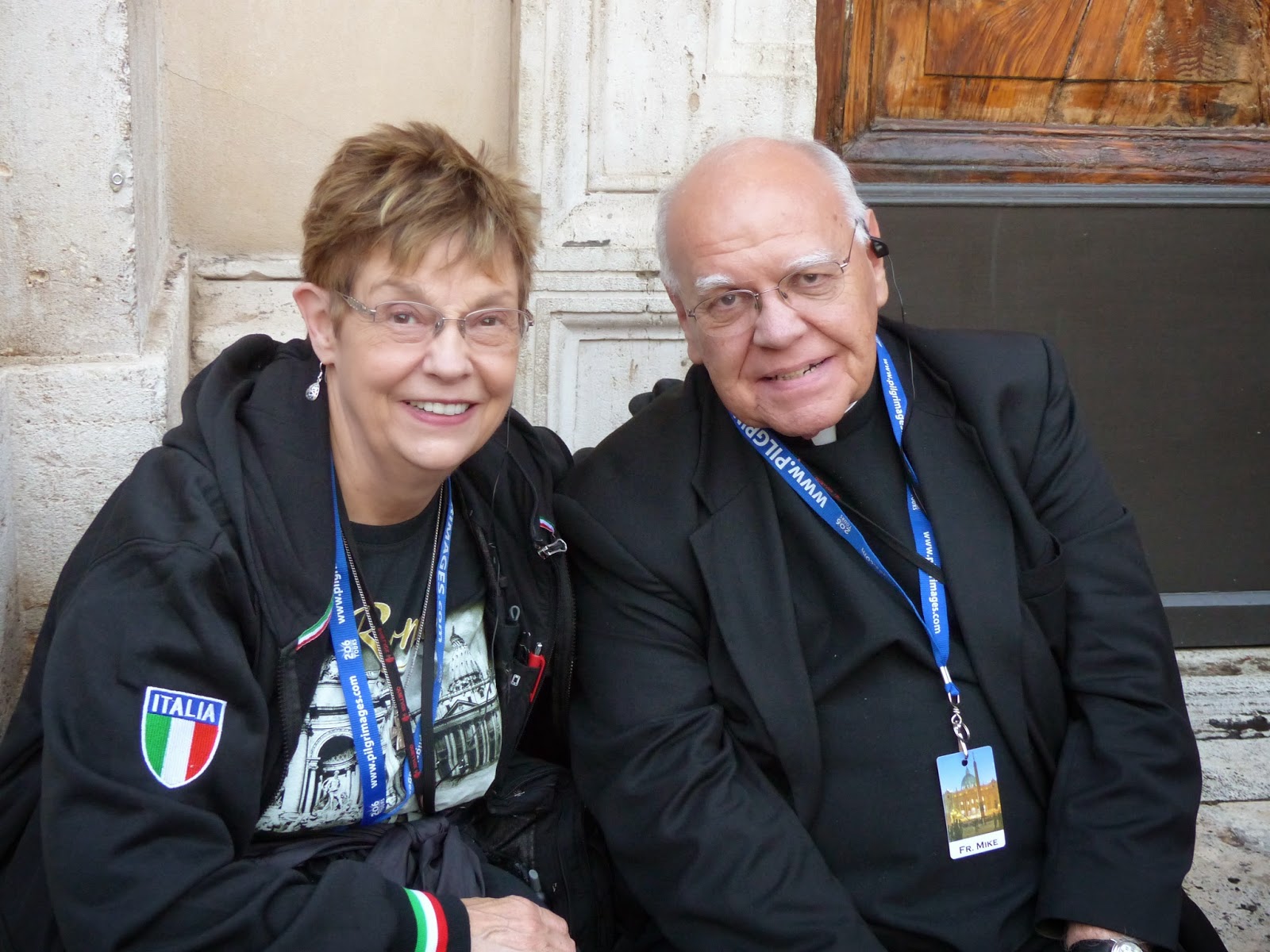
We thank God for Mary Johnston, who tirelessly went the extra mile for everyone in organizing, planning, leading, etc. -- and all this while being the victim of lost luggage! Mary didn't let this get her down, and instead, saw it as an opportunity to go shopping in Rome! Below is Mary Johnston on the left with Fr. Mike Phillips on the right.


A special thanks and blessing goes out to our faithful priests (Fr. Chris Podhajsky, Fr. Mike Phillips) and part-time Rome-based seminarian (part-time with us at least - Brother David Spillane) who made the trip and especially the liturgies a wonderful opportunity for spiritual growth and appreciation of our Catholic faith and roots! Brother David also shared his knowledge and love of the Catholic Faith with us on numerous occasions.

From left to right celebrating Mass ("ad orientem") at the tomb of Pope St. John Paul II: Fr. Chris, Fr. Mike, Fr. Brian Dellaert (former associate pastor at St. Jude's in CR . . . now studying canon law in Rome), and Brother David, serving at the altar. Fr. Brian joined us on several occasions during the pilgrimage, which was awesome!


From left to right: Fr. Mike, Fr. Chris, and Fr. Brian - celebrating Mass at the Basilica of Gregorio Septimo (Gregory VII):


To my fellow pilgrims -- thanks for the incredible trip and memories! It was so nice to make new friends and spend time getting to know you! Below is our group waiting to enter the Vatican Museums.


To my knowledge, we were all spared serious illness (other than swollen ankles, blisters, and fatigue) and theft of any kind! We all made it through airport Customs . . . with some taking longer than others . . . but making it out safely on the other end! Travel in both directions was without any serious snag or delay . . . except for the delayed final flight home from Chicago to CR, but that was a minor inconvenience.

When we arrived home in CR, Sister Susan (far right) had a welcoming committee waiting for her . . . all the way from Davenport! Fellow pilgrim from Davenport, Sharon Kieffert, is second from the left.


And to all of you following this blog -- thank you for your invaluable and much-needed prayers!

Well friends -- I'm not finished blogging about this pilgrimage quite yet -- I have a few more highlights to blog about (I fell behind in the final days), so stay tuned!

Wednesday, November 12, 2014

Leaving Rome this morning . . .

Friends: 

Please keep us in your prayers as our pilgrimage to Italy ends and we return home today (Thursday)!

Ciao Roma!

Chiesa Il Gesu & Relic of St. Francis Xavier

On Monday, we visited the Chiesa Il Gesu, the mother church of the Jesuits. It is incredibly beautiful!

The Chiesa Il Gesù (Church of the Gesù), a 16th-century late Renaissance church in Rome, is the mother church of the Society of Jesus, also known as the Jesuits.  Originally very austere, Il Gesù's interior was opulently decorated starting in the 17th century. Now its frescoes, sculptures and shrines make it one of the foremost examples of Roman Baroque art.  

The church  played a pivotal role in the Counter-Reformation, which was the Catholic Church's response to the Protestant Reformation of Martin Luther.  The Counter-Reformation's goals, worked out during the Council of Trent (1545-1563), were designed to reassert the power of the church, standardize the training of local priests, stimulate pious devotion, and wipe out the corruption in the church, which had fueled Luther's movement.

The left transept of the church houses the altar-tomb of St. Ignatius of Loyola, founder of the Jesuits.  The Jesuit artist Andrea Pozzo, himself a master of trompe l'oeuilfrescoes, won the commission for creating the altar. Utilizing silver, gold, bronze, rare marbles, and minerals like malachite, lapis lazuli, and porphyry, Pozzo employed over 100 craftsmen to create one of the wonders of Roman Baroque art. 

The original statue of the Saint was made of pure silver, but unfortunately it was melted down to pay taxes to Napoleon.  It has been replaced with a stucco replica covered with silver foil, but it is still stunning.  Every day at 5:30 p.m., a mechanical device designed by Pozzo plays impressive baroque music and lowers the painting of the saint to reveal the statue. 

To the right of the altar sits Pietro Le Gros' sculpture entitled The Triumph of Faith over Heresy.  This sculpture depicts Mary casting Martin Luther and his precursor, Jan Huss, out of heaven.  An attendant angel rips their translations of the Bible and their writings to shreds.  The militant nature of the Jesuits and their mission to spread the faith and reassert the power of the church is clear in this dramatic work.  A companion sculpture entitled “The Triumph of Faith over Idolatry” by Jean-Baptiste Theodon further cements the message of the Jesuits.


In the right transept of the church sits the Altar of St. Francis Xavier, the patron saint of Xavier High School in Cedar Rapids. Francis was one of the seven monks who, with St. Ignatius of Loyola, founded the Society of Jesus.  He was a notable missionary who spent years in India and Japan. Designed by Pietro da Cortona, the altar's multicolored marble columns frame a painting of the death of the saint by Carlo Maratta.  Cortona's silver reliquary contains the right forearm of the saint (see below), which is said to have converted some 300,000 souls.


Santa Maria Sopra Minerva

On Monday afternoon, we had Mass at Santa Maria Sopra Minerva, which is the only Gothic church in Rome. The Basilica of St. Mary over Minerva is so named because it was built directly on the foundations of a temple to Minerva, the goddess of wisdom.

Not much is known about the ruined temple to Minerva on this site, built by Pompey about 50 BCE and referred to as Delubrum Minervae. A temple to Isis and a Serapeum may also underlie the present basilica and its former convent buildings. Some Roman survivals can be seen in the crypt.

The ruined temple is likely to have lasted until the reign of Pope Zacharias (741-752), who finally Christianized the site, offering it to Eastern monks. The Christian structure he commissioned has disappeared.

The present building owes its existence to the Dominican Friars, who received the property from Pope Alexander IV (1254-1261) and made the church and adjoining monastery their influential headquarters. The Dominican Order administers the area today.

The church is located just behind the Pantheon in the Piazza della Minerva, and it's focal point is an endearing sculpture of a cheery baby elephant carrying a small Egyptian obelisk on his back. It was sculpted by Bernini in 1667. It is said to represent Pope Alexander VII's reign and illustrate the moral that strength should support wisdom.

The Egyptian obelisk is much older - it was found in the ruins of a temple of Isis that once stood nearby. Nothing visible remains of the Temple of Minerva (or Isis) over which the present church was built, but some Roman remains are visible in the crypt.


Saint Catherine of Siena (1347-1380), patroness of Europe, is buried under the altar (except her head, which is in Siena). The tomb includes an effigy of the virgin saint sculpted in 1430 by Isaia of Pisa. We were able to pray to St. Catherine, saint and doctor of the Church, right here.


Mass in a beautiful side chapel:


Basilica di Sant'Agostino di Roma

On Monday, we went to the Basilica di Sant'Agostino (Augustine) and it was especially nice to pray in front of St. Monica's tomb for her intercession for all the children in my life (nieces, nephews, Confirmation students and friends' kids) and their parents. 

St. Monica, the mother of the wayward St. Augustine, is the patron saint of mothers of wayward children, children who have left the Faith, or who have no faith. Monica is a faithful, persevering prayer warrior . . . look what happened to her son! Bishop, Saint, Father of the Church, theologian . . ! And this happened while she was still on earth! Think what can happen now that she's in heaven!

St. Monica, pray for us!

Tomb of St. Monica: